Category: Toyama Prefecture

  • A park that recreates Doraemon’s open lot

    A park that recreates Doraemon’s open lot

    A park that recreates Doraemon’s open lot in Takaoka City, Toyama Prefecture

    Takaoka City in Toyama Prefecture is the hometown where Fujiko F Fujio was born and raised. Since there are many Fujiko F Fujio’s works exhibited at the Takaoka Art Museum and other locations in Takaoka City, it is called “Doraemon’s hometown” by fans and tourists.

    Mr. Fujiko F. Fujio and Mr. Fujiko Fujio Ⓐ were classmates in elementary school

    Illustration of Fujiko FujioⒶ and Fujiko F Fujio

    Fujiko FujioⒶ was born in the adjacent city Himi, but moved to Takaoka City after his father passed away when he was in the fifth grade (1944), and was a classmate of Fujiko F Fujio at Takaoka Jozuka Elementary School (closed in 2022). Both Fujiko F Fujio and Fujiko FujioⒶ aspired to be cartoonists since their elementary school days, and when they were high school students (1951), they both debuted as cartoonists in a four-panel comic strip in “Mainichi Shougakusei Shimbun”. Takaoka City is where Fujiko F Fujio and Fujiko FujioⒶ lived until they moved to Tokyo at the age of 20. (In Himi City, there is “Ninja Hattori-kun Road” where Fujiko FujioⒶ’s works are on display.) Below are the main tourist spots related to Doraemon in Takaoka City.

    Takaoka City Fujiko F Fujio Hometown Art Gallery

    Takaoka City Fujiko F Fujio Hometown Art Gallery

    The “Takaoka City Fujiko F Fujio Hometown Art Gallery” is located on the second floor of the Takaoka Art Museum. Passing through the large “Anywhere Door,” visitors will find themselves in the world of Fujiko F Fujio. The “slide projector” that Fujiko F Fujio built in his childhood has been replicated, and “Memories of Hometown Takaoka” with his photographs and words is shown. Also, original drawings of “Doraemon” and other cartoons, original story book and other valuable works from his boyhood, as well as his favorite beret and the travelling bag he brought with him when he moved to Tokyo. There are also limited goods available only at the gallery.

    photo spot of the Fujiko F Fujio Hometown Gallery

    A limited-time photo spot has been set up in the Fujiko F Fujio Hometown Gallery.

    Doraemon’s Walkway

    Doraemon's Walkway of wing-wing Takaoka

    The square in front of Takaoka Station, named “Doraemon’s Walkway,” is home to 12 statues of characters from “Doraemon” (Doraemon, Nobita, Gian, Shizuka, Suneo, and Dorami).

    Doraemon Tram

    the Doraemon Tram

    The blue car on the Manyo Line, a tramline connecting Takaoka City and Imizu City, is the Doraemon Tram. It has been in operation since September 8, 2012, to mark the 100-year countdown to Doraemon’s birthday (Doraemon’s birthday is September 3, 2112.) The entrance to the tram is designed in the style of “Anywhere Door”. As you enter the tram, characters such as Doraemon and Nobita greet you, and secret tools such as the Time Machine and Small Light are scattered throughout the car. The Doraemon Tram has a fixed schedule, making six round trips a day between Takaoka Station and Koshinogata Station (about 50 minutes). The tram is closed on Wednesdays for inspection. A free ferry operates at Koshinogata as an alternative to the road and rail services since the port entrance was cut off by the construction of the Toyama New Port.

    Doraemon Post

    Doraemon Post of the waiting area of the Manyo Line at Takaoka Station

    A Doraemon post box (Doraemon Post) made of Takaoka copperware, a traditional craft of Takaoka, is in the waiting area of the Manyo Line at Takaoka Station. When you post a letter through the post, it will be delivered with Doraemon’s commemorative postmark. How about sending a letter as a memory of your trip to Takaoka?

    Doraemon’s open lot

    Takaoka Otoginomori Park (Takaoka Fairy Forest Park) , Draemon's open lot

    A 15-minute walk from JR Shin Takaoka Station on the Hokuriku Shinkansen Line brings you to Takaoka Otoginomori Park (Takaoka Fairy Forest Park). In Takaoka Otoginomori Park, there is a recreation of the open lot where Nobita and his friends always play (Doraemon’s open lot) in the manga “Doraemon,” and there is also a clay pipe where Gian’s recital is held. Doraemon and Nobita are smiling and waving, Gian is sitting on the clay pipe, and Suneo, Shizuka, and Dorami are arounds. It is a very popular tourist destination where visitors can enjoy the world of Doraemon.

    Access to Takaoka Art Museum

    From Tokyo

    It takes about 2 hours and 40 minutes from JR Tokyo Station to JR Shin-Takaoka Station by Hokuriku Shinkansen.

    From Osaka

    It takes about 1 hour and 30 minutes from JR Osaka Station to JR Tsuruga Station by limited express train. Transfer to the Hokuriku Shinkansen at JR Tsuruga Station and it takes about 1 hour to get to JR Shin-Takaoka Station.

    Get off at JR Shin-Takaoka Station and from JR Shin-Takaoka Station it takes about 10 minutes by taxi.

  • Ninja Hattori-kun Road

    Ninja Hattori-kun Road

    Himi City, Toyama is full of characters created by Fujiko Fujio Ⓐ! How exiting! Nin Nin!

    Himi City, Toyama Prefecture is the hometown of Fujiko Fujio Ⓐ, known for works such as “Ninja Hattori-kun,” “Kaibutsu-kun,” “Pro Golfer Saru,” and “The Laughing Salesman.” Many works of Mr. Fujiko Fujio Ⓐ are on display around “Kozenji temple” where he was born and Himimachi shopping street (also known as “Manga Road” or “Ninja Hattori-kun Road”). The area where these works are exhibited is collectively called “Fujiko Fujio Ⓐ Manga World.”

    Ninja Hattori-kun Automation Clock

    There is a bridge called “Niji no Hashi” (also known as “Ninja Hattori-kun Automation Clock“) that spans the Minato River, flows at the southern end of the Himimachi shopping street. At the scheduled time, the automation clock starts to move and Hattori-kun and Kemumaki, who is a rival to Hattori-kun, and the others have a ninja showdown. At the end of the show, Kenichi, a first son of the Mitsuba family who Hattori-Kun freeloads on, performs Shishimai Lion dance, a traditional performing art of Himi City.

    Himi City Shiokaze Gallery

    At the “Himi City Shiokaze Gallery” on “Manga Road (Ninja Hattori-kun Road),” “Ninja Hattori-kun” and “Kaibutsu-kun” sculptures as well as original drawings of “Pro Golfer Saru” and “The Laughing Salesman” are on display. You can take a photo with these sculptures.

    Kozenji Temple, the Daruma Daishi screen which looks like Moguro Fukuzou

    Kozenji Temple is an ancient temple of the the Soto Zen Buddhism with about a 700 year history, related to the Maeda family, the feudal lord of the Kaga Domain, and this is where Fujiko Fujio Ⓐ was born. His father was the 49th head priest of Kozenji Temple and the family lived here until they moved to Takaoka City, Toyama Prefecture when Fujiko Fujio Ⓐwas the fifth grade of elementary school. In the precincts, there are large stone sculptures of “Ninja Hattori-kun,” “Kaibutsu-kun,” “Pro Golfer Saru,” and “The Laughing Salesman.” The Daruma Daishi (founder of Zen Buddhism) screen, which looks like Moguro Fukuzou drawn by Fujiko Fujio Ⓐ and the desk that he inherited from Osamu Tezuka and used in Room 14 in Tokiwa-so are also on display. As a side note, Takaoka City in Toyama Prefecture is the hometown of Fujiko F Fujio. You can also enjoy the works by Fujiko F Fujio at Takaoka City Museum of Art.

     "Kaibutsu-kun Street" ("Kaibutsu Taro" "Dracula" "Franken" "Werewolf")

    In the area between JR Himi Station and the Ise-Omachi intersection (“Kaibutsu-kun Street”), there are four sculptures of the Prince of the Monster Land “Kaibutsu-kun”, “Dracula”, “Werewolf” and “Franken”.

    Pro Golfer Saru Pocket Park

    Chuo-machi Pocket Park (“Pro Golfer Saru Pocket Park”) along Route 415 is famous as a place representing the worldview of “Pro Golfer Saru” and great spot to take photos. There is a life-size sculpture of Sarumaru Sarutani, shooting super shots at an imaginary golf course that floats on the Tateyama Mountain Range and Toyama Bay drawn on the large wall. You can take a photo with the Sarumaru Sarutani sculpture.

    Himi City, Moguro Fukuzou Smile Bench

    There is a bench on which Moguro Fukuzou from “The Laghing Salesman” is sitting (“Moguro Fukuzou Smile Bench”). It is a popular photo spot where you can sit next to him. It is along Route 415, about 100m to the south of Minatogawa where “Ninja Hattori-kun Automation Clock” is located (Honmachi intersection).

    Himi Banya-gai, a photo cutout bord

    “Himi Banya-gai Harbour Market” is the Michi no Eki roadside station where you can enjoy seafood directly delivered from Toyama Bay and Himi fishing port, hot springs, and free footbaths. The “Kaibutsu-kun” wrapping bus is running from JR Himi Station to Himi Banya-gai. In “Himi Banya-gai”, there are Face Cutout Board of Fujiko Fujio Ⓐ’s four major characters, “Ninja Hattori-kun”, “Kaibutsu-kun”, “Pro Golfer Saru,”The Laughing Salesman” and also “Himibouzu-kun,” the mascot for Himi City designed by Fujiko Fujio Ⓐ. You can enjoy shooting photos with these characters by putting your face in the Face Cutout Board with a painted picture of ninja and boy.

    Ninja Hattori-kun Train

    On the JR Himi Line and JR Johana Line, there is the “Ninja Hattori-kun” wrapping train is running. On the train, Ninja Hattori-kun provides tourist information along the train line.

    Access to Hattori-kun Road (Himimachi Shopping Street)

    [Railway]

    From Tokyo

    It takes about 2 hours from JR Tokyo Station to JR Toyama Station by Hokuriku Shinkansen.

    From Osaka

    It takes about 1 hour and 30 minutes from JR Osaka Station to JR Tsuruga Station by limited express train. Transfer to the Hokuriku Shinkansen at JR Tsuruga Station, and it takes about 1 hour from JR Tsuruga Station to JR Toyama Station.

    [Airplane]

    It takes about 1 hour from Haneda Airport to Toyama Airport. It takes about 25 minutes from Toyama Airport to JR Toyama Station by shuttle bus.

    Transfer to the Ainokaze Toyama Railway at JR Toyama Station and it takes about 20 minutes to get to Takaoka Station on the Ainokaze Toyama Railway. Transfer to JR Himi Line at Ainokaze Toyama Railway Takaoka Station,about 30 minutes to JR Himi Station. About 15 minute- walk from JR Himi Station.

  • Gassho-zukuri houses in Gokayama

    Gassho-zukuri houses in Gokayama

    Gokayama may give you the impression of a peaceful and original Japanese landscape, but it was actually a military base where gunpowder was produced under the floors of Gassho-zukuri houses!

    “Gokayama” is a deep and rugged mountainous region located in the middle reaches of the Sho River, at the southwest tip of Toyama Prefecture (the border between Gifu Prefecture and Ishikawa Prefecture). Gokayama is a general term for 40 small villages and it is called Gokayama because it has 5 valleys (“go” means five and “yama” means mountain in Japanese). In Gokayama, there is a legend (end of the 12th century) that Heike refugees who were defeated by Yoshinaka Kiso (a cousin of Minamoto no Yoritomo and Yoshitsune) settled there, and also a legend that the 98th Emperor Chokei escaped (end of the 14th century). In the Edo period (from the 17th century), it functioned as a military base and as a penal colony for the Kaga Domain (now Ishikawa and Toyama Prefectures).

    <Gassho-zukuri house of Gokayama>

    Illustration of Gassho-zukuri Thatched House in Gokayama

    Gokayama is famous for its unique Gassho-zukuri thatched roof houses (“Historic Villages of Shirakawa-go and Gokayama”). Suganuma Village and Ainokura Village in Nanto City are registered as “World Cultural Heritage Sites” along with the Ogimach, Shirakawa Village in Shirakawa-go. Gokayama is very attractive because untouched nature still remains.

    <Iwase House Residence>

     Illustration of Gokayama Gassho-zukuri "Iwase House Residence"

    The “Iwase House Residence” is the largest Gassho-zukuri house in Gokayama and Shirakawa-go. It is a 5-story thatched house built about 300 years ago. The 3rd to 5th floors were used as workplaces for sericulture. More than 30 families lived here until the Meiji period, engaged in the core industry of sericulture. In addition, as it was the official residence for supplying the Kaga Domain with the gunpowder produced in Gokayama, it has the splendid interior made entirely of zelkova. It is designated as a national important cultural property. This residence is still inhabited, but you can tour the inside.

    <Salt Nitrate Highway>

    Schematic diagram of the “Ensho no Michi”

    Potassium nitrate is a raw material for black gunpowder, matches, and fireworks. In Japan, potassium nitrate is called “ensho”, which is literally written as “Flame nitrate (焔硝)”. During the Edo period, the Kaga Domain produced potassium nitrate (ensho), the raw material for black gunpowder in Gokayama. The Kaga Domain, which was a Tozama Daimyo*, secretly produced potassium nitrate (ensho) due to its relationship with the Tokugawa shogunate. In the Kaga Domain, potassium nitrate (ensho) was written as “Salt nitrate”. They used the character “塩 (salt)” instead of “焔(flame)”so that they could ostensibly produce it as “salt”. Both Salt and Flame are pronounced “en” in Japanese. Potassium nitrate was transported to Kanazawa using a mountain road not even on a map called the “Ensho no Michi (Salt Nitrate Highway)”, and in Kanazawa, it was mixed with sulfur and charcoal to produce black gunpowder. Since Gokayama was a penal colony for the Kaga Domain and was also an “isolated land island” that was isolated from other areas by mountains and valleys, it was perfect place to produce potassium nitrate (ensho) in secret.

    *Tozama Daimyo is the Daimyo feudal lord who served the Tokugawa family after the Battle of Sekigahara (1600). The Tokugawa shogunate was vigilant because some of them were Great Daimyos (Feudal Lords) such as the Maeda family (Kaga Domain), the Shimazu family (Satsuma Domain) and the Date family (Sendai Domain).

    <Under the floor of a gassho-zukuri house>

    Schematic diagram of Gokayama ensho (potassium nitrate) production

    In Japan at that time, it was well known that nitrater was naturally generated under the floors of old houses. Kaga Domain (Gokayama) systematically produced nitrate while other domains collected it from under floors. This is Aged-soil Method. A large 3.6m long hole, 1m wide and 2m deep was dug under the floor around the irori hearth, and buckwheat husks, mugwort, hemp and other hay and silkworm feces were alternately piled up in layers, and human urine was poured over them. Under the heat of the hearth, people fermented these for 4 to 5 years to produce nitrate. This is Cultural Method.

    <Ensho no Yakata (Nitrate Museum)>

    An illustration of a simulated matchlock gun experience at the "Ensho no Yakata"

    At the Ensho-no-Yakata (Nitrate Museum), you can learn how salt nitrate (ensho) is collected and shipped. Matchlock guns are also on display and you can try a simulated matchlock gun.

    <Gokayama Washi no Sato>

    Gokayama (Illustration of paper making experience)

    “Gokayama Washi no Sato” attached to “Michi-no-Eki Taira” introduces the history, manufacturing process, and products of Gokayama Washi paper, which is one of basic industries in Gokayama. You can experience making Washi paper.

    <Gokayama Tofu>

    Illustration of Gassho-zukuri house and Gokayama tofu

    In Gokayama, you can experience “Gokayama tofu” making with the clear water of Gokayama and local soybeans. Traditional “Gokayama tofu” is hard tofu that does not lose its shape even when tied with a rope. There are shops and restaurants that sell Gokayama tofu.

    <Kago no Watashi>

    Illustration of "Kago no Watashi" on display in Gokayama

    Since Gokayama was once a penal colony of the Kaga Domain, it was not possible to build a bridge. When crossing the river to the opposite bank, they stretched out a rope made of vines and rode in a basket to cross the river. Suganuma village has an exhibition of “Kago no Watashi”, an ancient method of crossing the river similar to a primitive cable car.

    Access to Gokayama

    [Railway]

    From Tokyo

    It takes about 3 hours from JR Tokyo Station to JR Shin-Takaoka Station by Hokuriku Shinkansen. From JR Shin-Takaoka Station take a World Heritage bus for about 1 hour to Ainokuraguchi bus stop and a World Heritage bus for about 1 hour 15 minutes to Suganuma bus stop. * About two hours from JR Shin-Takaoka Station to Shirakawa-go by World Heritage Bus.

    From Osaka

    It takes about 1 hour and 20 minutes from JR Osaka Station to JR Tsuruga Station by JR Tokaido Main Line (limited express). Transfer to the Hokuriku Shinkansen at JR Tsuruga Station and get to JR Kanazawa Station in about 40 minutes. Get off at JR Kanazawa Station and from JR Kanazawa Station take the highway bus (reservation required) to Gokayama (Suganuma). Alternatively, it takes about 1 hour by Hokuriku Shinkansen from JR Tsuruga Station to JR Shin-Takaoka Station. From JR Shin-Takaoka Station take a World Heritage bus for about 1 hour to Ainokuraguchi bus stop and a World Heritage bus for about 1 hour 15 minutes to Suganuma bus stop. * About two hours from JR Shin-Takaoka Station to Shirakawa-go by World Heritage Bus.

    [Airplane]

    From Tokyo

    It takes about 1 hour from Haneda Airport to Toyama Airport. It takes about 30 minutes from Toyama Airport to Toyama Station by local bus. Transfer to the Ainokaze Toyama Railway Line at JR Toyama Station and it takes about 20 minutes to JR Takaoka Station. From JR Takaoka Station you can take a World Heritage bus to Ainokuraguchi bus stop in about 1 hour 15 minutes, and a World Heritage bus to Suganuma bus stop in about 1 hour 30 minutes. Alternatively, it takes about 1 hour from Haneda Airport to Komatsu Airport. It takes about 40 minutes from Komatsu Airport to JR Kanazawa Station by shuttle bus. It takes about 1 hour from JR Kanazawa Station to Gokayama (Suganuma) by highway bus (reservation required).

    From Fukuoka

    It takes about 1 hour and 30 minutes from Fukuoka Airport to Komatsu Airport. It takes about 40 minutes from Komatsu Airport to JR Kanazawa Station by shuttle bus. It takes about 1 hour from JR Kanazawa Station to Gokayama (Suganuma) by highway bus (reservation required).

  • Kurobe Dam

    Kurobe Dam

    I’ll tell you the secret to seeing a rainbow for sure at the very famous sightseeing water discharge of the Kurobe Dam, which will make even people who are not interested in dams into dam lovers.

    Kurobe Dam is a dedicated hydroelectric dam built on the Kurobe River, which flows through the town of Tateyama in Toyama Prefecture. It is also called the Kuroyon Dam because it supplies water to the Kurobe River No.4(“yon” in Japanese) Power Plant of Kansai Electric Power Co., Inc.  The sightseeing water discharge, which has become a tourist attraction at the Kurobe Dam, is held from late June to mid-October every year, from 6:30 am to 5:00 pm. The time varies by 30 minutes depending on the season.

    <Sightseeing water discharge of Kurobe Dam>

    Kurobe Dam Illustration of sightseeing water discharge

    The sight of the huge volume of water (more than 10 tons per second) flowing down with a plume of water is breathtaking. If the weather is fine and the sun shines in the morning, you can see a beautiful rainbow over the water discharge.

    <History of dam construction>

    Image Illustration of 1950s Japan

    At the time when the construction of the Kurobe Dam was decided, Japan was in a period of rapid postwar economic growth, and it took seven years to complete the project in 1963 to alleviate the severe power shortage in the Kansai region. The total construction cost was 51.3 billion yen at that time (about half of the sales of Kansai Electric Power Co., Inc. in those days, which is said to be over 1 trillion yen in today’s money value), and a total of 10 million people were employed to build it.

    <Structure of Kurobe Dam>

    Structural drawing of Kurobe Dam

    The weir of the Kurobe Dam is 492 meters long and 186 meters high, making it the tallest arch-type concrete dam in Japan. Kurobe Dam is a domed arch-type dam, which is mechanically superior among arch-type dams, and is curved downstream, just like a rice bowl split vertically. Compared to a normal arch-type dam, a domed dam allows water pressure to escape to the lower part of the embankment so that the water pressure exposed to the embankment is equal between the upper and lower parts of the dam. Arch-type dams are a very economical dam system because the mechanical properties of the arch allow water pressure to escape to the bedrock on both banks, and the weir can be made thinner than that of a gravity-type dam. However, in 1959, the Malpasset Dam, an arch-type dam in France, collapsed, killing 500 people. The cause of the collapse was said to be insufficient strength of the bedrock on both banks. In response, the Kurobe Dam was redesigned with gravity-type dam wings on both wings of the arch-type dam so that the bedrock on both banks could withstand the water pressure.

    <Difficult construction project of the century>

    Kurobe Dam Illustration of the difficult construction project of the century

    The Kurobe Dam is located on the border between Toyama and Nagano Prefectures, surrounded by 2000-3000-meter-high mountains. At the beginning of the dam construction, construction materials were transported manually from the Toyama Prefecture side, but this did not work well, so a tunnel was constructed from the Nagano Prefecture side through Mt. Akazawa-dake (elevation: 2678 m). This tunnel is the present-day Kanden Tunnel, but it was such a difficult construction that it is called “the difficult construction project of the century” due to a large amount of groundwater gushing out of the fracture zone in the tunnel.

    <Filming set of the movie “Kurobe no Taiyo”>

    Kurobe Dam Illustration of the filming set of the movie “The Sands of Kurobe (Kurobe no Taiyo)”

    At Kurobe Dam, the filming set for the movie “The Sands of Kurobe (Kurobe no Taiyo)” (released in 1968) starring Mr. Yujiro Ishihara and Mr. Toshiro Mifune, which depicts the struggles of the construction of the Kanden Tunnel, is on display.

    <Tour of the fracture zone>

    Kurobe Dam Illustration of the tour of the fracture zone

    The fracture zone is a soft stratum that holds groundwater and is difficult to dig through because it spews out gravel and muddy water when dug. Kurobe Dam regularly offers tours of the fracture zone in the Kanden Tunnel.

    <Cenotaph>

    Kurobe Dam Illustration of the cenotaph

    171 people were killed in the dam construction, and the cenotaph with the names of those killed has been placed at the Kurobe Dam.

    <Tateyama Kurobe Alpine Route>

    Illustration drawing of Tateyama Kurobe Alpine Route

    To reach Kurobe Dam, visitors use a transportation route called the Tateyama Kurobe Alpine Route, which has a total length of 37.2 km, and a dedicated transportation system. Kurobe Dam is located in Toyama Prefecture but is deep in the mountains on the border with Nagano Prefecture, so access from the Toyama side requires nearly 3 hours from Tateyama Station to Kurobe Dam. On the other hand, access from the Nagano Prefecture side is much faster, taking only 15 minutes from Ogizawa Station to Kurobe Dam. Access to the Kurobe Dam from the Toyama side inevitably takes longer because it requires crossing Mount Tate (elevation: 3015m), but this is compensated for by the spectacular views of the Murodo and the Tateyama mountain range.

    <Kurobe Route Tour>

    Kurobe Dam Illustration of Kurobe Route Tour

    In the Kurobe Gorge, there is the Kansai Electric Power Co., Inc. work transportation route that connects the Kurobe Gorge Railway’s Keyakidaira Station to the Kurobe River No.4 Power Station and then to the Kurobe Dam Station in the Kanden Tunnel (about 18 km), and the entire section is almost entirely tunneled. It is called the “Kurobe Route,” and trains, work cable cars (Incline), and buses operate there to transport people and goods related to Kansai Electric Power Co., Inc.

    On this Kurobe Route, visitors can take the Kurobe Route Tour, which includes a visit to the Kurobe River No. 4 Power Plant, a ride on the Incline, and an experience of the novel “Konetsu Zuido,” which was written about the construction of the power plant at the Senjindani Dam (Kurobe River No. 3 Power Plant).

    Illustration of Nakajima Miyuki singing “The Star on the Earth" at Kurobe River No.4 Power Station

    Kurobe River No.4 Power Station, located in the tunnel, is where Ms. Nakajima Miyuki sang “The Star on the Earth” during the NHK Kohaku Uta Gassen broadcast on December 31, 2002, which became a hot topic.

    Access to Kurobe Dam

    From Tokyo

    It takes about 1 hour and 30 minutes from JR Tokyo Station to JR Nagano Station by Hokuriku Shinkansen. Get off at JR Nagano Station and take limited express bus from Nagano Station East Exit bus stop to Ogizawa bus stop in about 1 hour and 45 minutes.

    From Osaka

    It takes about 50 minutes by Tokaido Shinkansen from JR Shin-Osaka Station to JR Nagoya Station. At JR Nagoya Station, transfer to JR Chuo Main Line (limited express) to JR Matsumoto Station in about 2 hours. From JR Matsumoto Station, transfer to JR Oito Line to JR Shinano-Omachi Station. Get off at JR Shinano-Omachi Station and take local bus from Shinano-Omachi Ekimae bus stop to Ogizawa bus stop in about 40 minutes.

    It takes about 15 minutes from Ogizawa Station to Kurobe Dam Station by Kanden Tunnel Electric Bus.

  • Kurobe Gorge

    Kurobe Gorge

    Let’s check the highlights before getting on Trokko in Kurobe Gorge! I will introduce 8 popular spots along the Kurobe Gorge Railway line.

    Kurobe gorge is the Hida Mountains (commonly known as North Alps) that across 4 prefectures of Toyama, Gifu, Nagano and Niigata. Among them, Kurobe gorge is the most precipitous large V-shaped valley in Japan which flow from the middle to the upper stream of Kurobe river to the east of Toyama prefecture, In Kurobe gorge, Torokko (the trolley train) is running. “Trokko” is a freight car that carries soils and stones from construction sites and English truck is its word origin.

    Kurobe Gorge Railway

    Illustration of Kurobe Gorge Railway trolley train

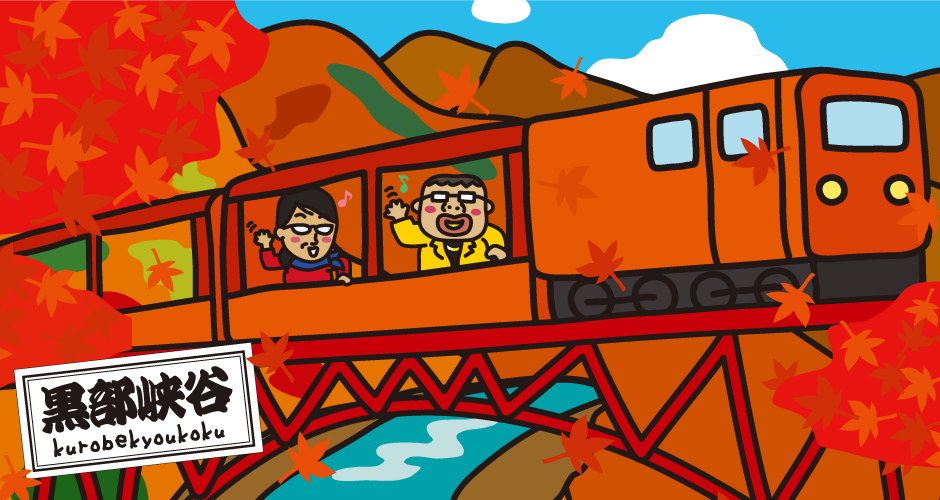
    Trokko in Kurobe gorge originally operated as a work train that transport construction materials for Kurobe dam since 1923. From 1953, it started to operate as a passenger train. There are total of 10 stations on the railway line, however the station you can get on and off are only four that are the first “Unazuki station”, “Kuronagi station”, “Kanetsuri Station” and the last “Keyakidaira station”. Other stations are just passing by because those stations are for people who are related to power plant and dam get on and off. The travel distance from Unazuki station to Keyakidaira station is 20.1km and it takes approximately 1 hour and 20 mins for one way. You will go through 41 tunnels and cross 21 bridges. There are two types of passenger cars. One is an open car with a simple rain shelter and the other one is a luxury car with a roof and glass windows.

    Shin-Yamabiko bridge

    Illustration of Kurobe Gorge Railway trolley train crossing the red iron bridge “Shin Yamahiko Bridge”

    The red iron bridge that the train will across first when you depart from Unazuki station is “Shin-Yamabiko bridge (New echo bridge)”. As the sound of the train become echoes and turn into a hot spring town, this name was given to that bridge. The red bridge just beside is “Yamabiko Bridge” that was used to be a track of Torokko and now it is a part of a promenade. If you check the arrival and departure time of Trokko at Unazuki station, you can shoot Trokko crossing Shin-Yamabiko bridge.

    Bridge for Monkeys only

    Kurobe Gorge Illustration of a bridge for monkeys only

    After the dam construction, a bridge for monkeys are made so that monkeys could across over the dam to the other side even if the water is stored. You can see it from the train window.

    Unazuki lake

    Unazuki Lake in Kurobe Gorge Illustration of Shin Yanagiwara Power Station inspired by a western castle

    On the lakeside of Unazuki lake, there is a hydraulic power plant made with the impression of the Western castle. There is a station near power plant, but you cannot get on and off because this is a private station for people working at power plant. You can see it from the train window.

    Atobiki Bridge

    Kurobe Gorge Railway Illustration of Kuronagi Station on the Atobiki Bridge over the Kuronagi River

    A part of Kuronagi station home is located on the iron bridge “Atobiki Bridge” that crosses Kuronagi river. Atobiki Bridge is a blue color bridge over deep and steep valley that people afraid of. Its height is 60m and length is 64m. Because it is a deep valley that people afraid and step back when they look down the it. So, it was named as “Atobiki Bidge”. Atobiki in Japanese means “step back from something”.

    Kurobe Perpetual Snow Observation Deck

    Kurobe Gorge Railway Illustration of “Mannen Yuki Observation Deck” at Kanetsuri station

    As soon as you get off Kanetsuri station, you will find “Kurobe Mannen Yuki Observation Deck (Kurobe Perpetual Snow Observation Deck)”. The snow fell on the mountain on the other side across Kurobe River is lain as avalanche and remain until the next winter’s new snowfall. So, it is called perpetual snow. The amount of snow is heavy every year until around May.

    Open-air bath of Kanetsuri hot spring

    Kurobe Gorge Railway Illustration of open-air bath of Kanetsuri hot spring near Kanetsuri station

    There is an open-air bath of Kanetsuri hot spring in the river that you walk down from the Kanetsuri station. At there, Kurobe river flows right in front of you. You can enjoy making your own outdoor hot spring because a hot spring wells up from anywhere. But many tourist goes to Kanetsuri hot spring, so most people just enjoy footbath at here.

    Sarutobi Gorge

    Kurobe Gorge Illustration of Sarutobi Gorge

    There is “Sarutobi Gorge (Monkey jumping gorge)” where walked about 30 minutes from Keyakidaira station. Sarutobi Gorge has the narrowest river width in Kurobe River and monkeys can also jump to across the river, so it was named as Sarutobi Gorge. It is the typical landscape of Kurobe gorge and its landscape is designated as a place of special scenic beauty and special natural monuments.

    People-eating Crag

    Kurobe Gorge Railway’s Keyakidaira Station Illustration of “Hitokui Iwa," an overhanging bedrock that looks like it is swallowing a person walking with a big mouth open

    Finally, get off at the end point, Keyakidaira station. As soon as you cross Okukane Bridge, there is Hitokui Iwa (People-eating Crag). The projecting rock cliff seems to be opening mouth and try to swallow walkers, so it is called as Hitokui Iwa (People eating Crag). At there, a helmet is prepared for your own safety. If you go further in the direction along Hitokui Iwa from Babadani River, there are “Babadani Jigoku(Babadani Hell)” and “Babadani hot spring”. In Babadani area, steams of hot springs are rising up from the ground everywhere. So, people are afraid to approach there and in Japan, such hot springs are called as “hell”.

    Kurobe Route

    Kurobe Gorge Railway Illustration of the Kurobe Route tour held on the transportation route between Keyakidaira Station and Kurobe Dam

    There is a transportation route between Keyakidaira Station and the Kurobe Dam, called the Kurobe Route, whose entire section (about 18 km) is almost entirely tunneled. This tunnel was excavated for the construction of the Kurobe River No. 4 and No. 3 power plants, and even today, trains and work cable cars (incline) are still in operation to maintain the power generation facilities and transport materials. The Kansai Electric Power Co., Inc. is organizing a tour of the Kurobe Route to let as many people as possible know about its hydroelectric project.

    Access to Kurobe Gorge Railway Unazuki Station

    From Tokyo

    It takes about 2 hours 30 minutes from JR Tokyo Station to JR Kurobe Unazuki Onsen Station by Hokuriku Shinkansen and get off at JR Kurobe Unazuki Onsen Station. From JR Kurobe-Unazuki Onsen Station to Toyama Chitetsu Shin-Kurobe Station, it takes 5 minute-walk. It takes about 25 minutes from Toyama Chitetsu Shin-Kurobe Station to Toyama Chitetsu Unazuki Onsen Station, get off at Toyama Chitetsu Unazuki Onsen Station and walk about 5 minutes to Kurobe Gorge Railway Unazuki Station.

    From Osaka

    It takes about 1 hour and 20 minutes from JR Shin-Osaka Station to JR Tsuruga Station by JR Tokaido Main Line (limited express). Transfer to the Hokuriku Shinkansen at JR Tsuruga Station and get to JR Kurobe Unazuki Onsen Station in about 1 hour and 40 minutes.

  • “Throwing oneself of firefly squid” is a spring feature of Toyama Bay.

    “Throwing oneself of firefly squid” is a spring feature of Toyama Bay.

    If you think that you can see firefly squid anytime you go there, you will be disappointed with the gap between your expectation and the reality. So, please do not hesitate to go “HOTARUIKA Museum (firefly squid museum)”.

    Every year from March to May, large numbers of firefly squid, glowing blue and white, are washed up in the surf by the waves along the coast of Toyama Bay from Toyama City to Uozu City, centering on Namerikawa City, Toyama Prefecture. This scene is known as the “Hotaruika no Gunyuukaimen – Firefly squid swarming sea surface,” and is designated as a special natural monument in Japan. Incidentally, firefly squid themselves have not protected species, so it is okay to catch and eat firefly squid.

    Life Zone of Firefly Squid (Illustration of the Distribution Depth of Firefly Squid)

    Firefly squid are annual migratory fish, small squid weighing 10 grams, 4 cm to 5 cm for males, and 5 cm to 7 cm for females, whose entire body emit a bluish-white light when stimulated. They usually live in deep water at depths of 200m to 300m, but at night they surface at depths of 30m to 100m in search of food. They gather in Toyama Bay during the spawning season from March to May.

    Origin of the name firefly squid

    Long time ago in Toyama, people used firefly squids as fertilizers for pine trees so people called them “matsuika (pine tree squid)”. Since 1905, its name became “firefly squid” because Dr. Shozaburo Watase of University Tokyo who studied ecology of firefly named it as “a squid that emit light like firefly”.

    The reason why firefly squid emit light (illustration of firefly squid's intimidation and camouflage)

    Firefly squid emit light through a chemical reaction between a luminescent substance (Luciferin) and a luminescent enzyme (Luciferase). This light is called “cold light” because it has no heat. This is almost the same mechanism by which fireflies emit light. Firefly squid have luminescent organs on their entire skin, arms, and around their eyes, each with a different role, but firefly squid emit light for two main reasons. First, when they come into contact with enemies, the tips of their two arms (the fourth arm) emit a strong light to intimidate them. Second, firefly squid are brown when swimming in the deep sea, but when they rise to the surface, the light shining into the sea causes their shadow to appear, and to prevent them from being targeted by enemies from below, they camouflage themselves by emitting light on their ventral side. (There are about 1000 luminous organs on the ventral side, but very few luminous organs on the dorsal side.)

    Habitat of the firefly squid (illustration of the theory of firefly squid's migration to the Sea of Japan)

    Firefly squid are widely distributed in the seas around Japan but are mainly found in the waters off the San’in region and off the Akita region of the Sea of Japan. One theory is that the waters off the San’in region are thought to be the spawning grounds of firefly squid. Firefly squid hatch in early spring and move northward on the Tsushima Warm Current, becoming adults from off the Noto region to off the Akita region, and then move southward to spawn off the San’in region the following spring. It is supposed that firefly squid that split off from the main current enter Toyama Bay during this southward migration, and Toyama Bay is the only place in the world where you can see the sight of large numbers of firefly squid rushing into the bay (the “Hotaruika no Gunyuukaimen – Firefly squid swarming sea surface”). Incidentally, firefly squid spawn at night, rising to the surface from a depth of about 200 meters in Toyama Bay to the coast. Most of the firefly squid that come to the surface are females. Males mate in the deep sea and live out their lives. (Firefly squid’s mating season is from November to February.)

    The comparative chart between fixed fishing nets and bottom trawling nets for firefly squid

    Firefly squid are a well-known mystery of Toyama Bay, but the catch of firefly squid is actually larger in Hyogo Prefecture than in Toyama Prefecture. This is due to the difference in fishing methods. In Toyama Prefecture, firefly squid that surface in Toyama Bay to spawn are caught in fixed fishing nets, whereas in Hyogo Prefecture, firefly squid swimming at a depth of about 200 meters are caught in bottom trawling nets. Firefly squid caught in Toyama Prefecture are traded at a higher price in the market because they are only full-figured females that have stored nutrients for spawning.

    Conditions for the “Hotaruika no Minage - Firefly squid oneself throwing (Firefly squid suicide)” relationship between firefly squid and the new moon and high tide

    Conditions for the “Hotaruika no Minage - Firefly squid oneself throwing (Firefly squid suicide)” - mechanism of land breezes and upwelling currents in Toyama Bay

    Firefly squid that have washed up are known as “Hotaruika no Minage – Firefly squid oneself throwing” (meaning firefly squid suicide). It is not always easy to see even from March to May in Toyama Bay. According to locals, large numbers of firefly squid may be washed up in the surf, depending on the following conditions. -New Moon and two days before and after, high tide from midnight to dawn -Calm waves and land breezes (southerly winds in the case of Toyama Bay) *When land breezes blow, upwelling currents occur in Toyama Bay, causing deep water to rise up near the surface and deep-sea creatures to rise to the surface together.

    Firefly squid throwing / Firefly Squid Scooping

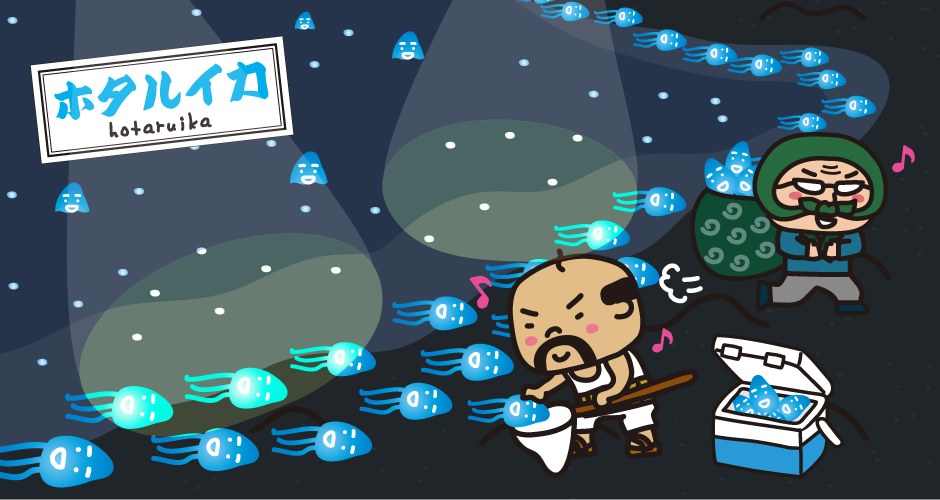
    Incidentally, firefly squid that have washed up on the beach are not suitable for eating because they are chewing sand. If edible, catch firefly squid floating on the surface of the sea before they are washed up on the beach by scooping them up with Tamo nets or something like that.

    Firefly Squid Museum Firefly Squid Light Show

    “HOTARUIKA museum” is a museum that its theme is firefly squid and its building is shaped as a body of firefly squid. From the middle of March to the end of May, in the season of firefly squid fishing season, the lightning show of live firefly squid is held and you can touch firefly squid directly with your bare hands. (During the off-season, you can watch the light emitting image of firefly squid by LED lights.)

    ほたるいか海上観光(滑川漁港)のイラスト

    “Firefly squid tourism at sea” will be held every year from the middle of April to the early May. From Namerikawa fishing port, sightseeing ships will sail before daybreak, and you can observe firefly squid fishing and how firefly squid emit light at a fishing spot.

    Access to HOTARUIKA Museum (Firefly Squid Museum)

    [Railway]

    From Tokyo

    It takes about 2 hours from JR Tokyo Station to JR Toyama Station by Hokuriku Shinkansen.

    From Osaka

    It takes about 1 hour and 30 minutes from JR Osaka Station to JR Tsuruga Station by limited express train. Transfer to the Hokuriku Shinkansen at JR Tsuruga Station, and it takes about 1 hour from JR Tsuruga Station to JR Toyama Station.

    [Airplane]

    It takes about 1 hour from Haneda Airport to Toyama Airport. It takes about 25 minutes from Toyama Airport to JR Toyama Station by shuttle bus.

    Transfer to the Ainokaze Toyama Railway at JR Toyama Station to get to Namerikawa Station on the Ainokaze Toyama Railway in about 15 minutes. About 10 minute-walk from Namerikawa Station on the Ainokaze Toyama Railway.